
In psychology, the term phobia is defined as an intense, irrational, and persistent fear of a specific object, situation, or activity. As it turns out, there is a type of phobia that describes the fear of deep bodies of water: thalassophobia, where thalassa is the ancient Greek word for sea.
I would argue that this term does not apply to the Drake Passage. Why? Because fear here isn’t irrational — it’s entirely logical. This 600-mile (950 km) wide gap between the southern tip of South America and the South Shetland Islands of Antarctica contains some of the roughest, most continuous seas on the planet. Maritime records suggest that at least 10,000 sailors have lost their lives to these treacherous waters over the centuries.

What Is the Drake Passage?
The Drake Passage is a body of water connecting the Atlantic Ocean, the Pacific Ocean, and the Southern Ocean. It lies between Cape Horn at the southern tip of South America and the South Shetland Islands of Antarctica. It is widely regarded as the most treacherous stretch of open water on Earth and a mandatory crossing for nearly all Antarctica cruises departing from Ushuaia, Argentina.
| Stat | Detail |
|---|---|
| Width | 600 miles (950 km) |
| Average Crossing Time | 36–48 hours |
| Departure Port | Ushuaia, Argentina |
| Arrival Point | South Shetland Islands, Antarctica |
| Oceans Converging | Pacific, Atlantic, and Southern Ocean |
| Wind Classification | "Screaming Sixties" (~60°S latitude) |
| Dominant Current | Antarctic Circumpolar Current (ACC) |
| ACC Flow Rate | ~135 million m³/sec (approx. 600× the Amazon) |
| Wave Heights (Severe) | Up to 10–15 meters |
| Historical Casualties | ~10,000 sailors (centuries of maritime record) |
| Cruise Season | November–March (Southern Hemisphere summer) |
Departing Ushuaia: The Calm Before the Drake
The journey didn’t begin with chaos. Departing from the port of Ushuaia — the world’s southernmost city and the standard embarkation point for Antarctica cruises — the first dozen or so hours were smooth sailing as the ship moved east through the Beagle Channel toward the Atlantic. We turned south near Picton Island (Isla Picton), navigating the last few islands down to Cape Horn: the final scrap of land for the next 600 miles. It is from this point that the “fun” starts.
What Does It Feel Like to Cross the Drake Passage?
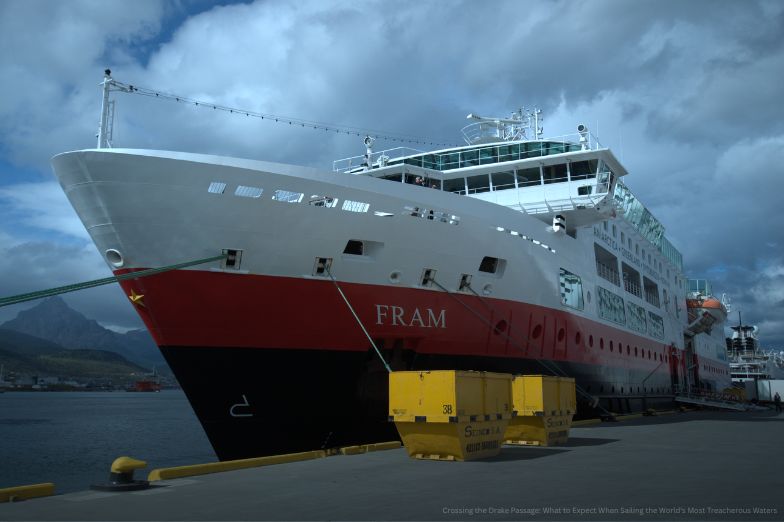
By the early morning of the second day, we were well into the passage. On our vessel — the Hurtigruten MS Fram — breakfast took on a completely new meaning. Eating becomes a feat of physics when the floor beneath you is tilting 30 degrees. Watching passengers and crew alike perform a synchronized stumble while trying to balance eggs on a plate is a spectacle in itself. Looking through the windows surrounding the galley, the horizon was never a constant line — one moment you are staring at a wall of slate-gray swell, and the next, you are looking directly into a heavy, low-hanging sky.
Drake Lake or Drake Shake? What We Got
Among Antarctica travelers, there are two unofficial outcomes to the Drake crossing. The table below breaks down what each actually means on the water — we got the Shake.
| Drake Lake 🌊 | Drake Shake 🌊🌊🌊 | |
|---|---|---|
| Sea State | Calm, low swell conditions | Heavy, continuous rolling swells |
| Wave Height | 0.5–2 meters | 3–15 meters |
| Wind | Light breeze | Gale-force sustained winds |
| Frequency | Rare | Common |
| Passenger Experience | Comfortable, enjoyable | Challenging; seasickness likely |
| Wildlife Visibility | Excellent | Difficult in rough conditions |
| Photography Conditions | Ideal | Challenging |
By mid-afternoon of the second day, the ship felt less like a vessel and more like a living thing, groaning and flexing against the Southern Ocean. While most travelers had retreated to their cabins, clutching scopolamine patches like holy relics, those of us who stayed on the bridge were rewarded. I was surprised that I didn’t succumb to seasickness here — I have before on deep-sea fishing trips off the coast of California, and it is a horrible, gut-wrenching feeling.
Why Is the Drake Passage So Rough? Three Forces at Work
There are three primary factors that create this maritime mayhem.
1. The Triple Ocean Convergence
The Drake Passage is the unique “choke point” where the Pacific, Atlantic, and Southern Oceans meet. It is the only place on Earth where the world’s oceans are squeezed through a narrow bottleneck, creating a high-pressure funnel for massive volumes of water.
2. The Unimpeded Wind (The "Screaming Sixties")
At these latitudes — known as the “Screaming Sixties” — there is no landmass to break the wind. These gales whip around the bottom of the globe completely unimpeded, picking up speed and energy until they slam through the Drake Passage. The result is sustained winds and wave heights that few other places on Earth can match.
3. The Antarctic Circumpolar Current (ACC)
This is the strongest ocean current on Earth. The ACC carries roughly 135 million cubic meters of water per second — about 600 times the flow of the Amazon River. When this current hits the varying depths of the seafloor in the passage, it generates massive, turbulent swells that can reach 10 to 15 meters in severe conditions.
Surviving 36 Hours in the Drake Passage
We crossed the Drake Passage in just over 36 hours after passing Cape Horn. It wasn’t thalassophobia I felt out there. It was a profound, humbling respect for the only place on Earth where nature still refuses to be tamed.
While the immediate relief of reaching the South Shetlands was palpable, a quiet anxiety remained. In the back of every passenger’s mind was the knowledge that this was not a one-way rite of passage. In roughly ten days, we would have to turn our bow north and face the “Shake” all over again. For now, the violent oceans were behind us — but the Drake was merely on hiatus, waiting for our return journey across the world’s most turbulent waters.
How to Prepare for the Drake Passage Crossing
Whether you get a Lake or a Shake, preparation makes a measurable difference. Here is what actually works — and what to do with it:
| Category | What to Do | Notes |
|---|---|---|
| Seasickness | Scopolamine patch | Prescription only. Apply 4–6 hours before sailing. |
| Seasickness | Meclizine (Bonine/Antivert) | OTC antihistamine. Mild drowsiness is common. |
| Seasickness | Acupressure wristbands | Non-pharmaceutical option. Best used alongside medication. |
| Food & Drink | Light, frequent meals | Avoid heavy or greasy food before and during the crossing. |
| Food & Drink | Stay hydrated | Dehydration can make nausea significantly worse. |
| On Deck | Fresh air and focus on the horizon | Keep your gaze on the horizon instead of walls, screens, or books. |
| Clothing | Waterproof outer layer | Deck spray is common even in moderate conditions. |
| Footwear | Non-slip deck shoes | Critical when the floor is pitching 20–30 degrees. |
| Cabin Choice | Request a midship cabin on a lower deck | Least motion felt at the ship's center of gravity. |
| Mindset | Know the timeline | The Drake crossing is typically 36–48 hours — it ends. |
Frequently Asked Questions About Crossing the Drake Passage
How long does it take to cross the Drake Passage?
Most Antarctica cruises cross the Drake Passage in approximately 36 to 48 hours, depending on the ship’s speed and sea conditions. The crossing from Cape Horn to the South Shetland Islands covers roughly 600 miles (950 km).
What is the Drake Passage?
The Drake Passage is a 600-mile (950 km) wide stretch of open water between the southern tip of South America (Cape Horn, Argentina) and the South Shetland Islands of Antarctica. It is the point where the Atlantic, Pacific, and Southern Oceans converge, making it the roughest and most treacherous sailing route on Earth.
What causes the rough seas in the Drake Passage?
Three primary forces combine to create the Drake Passage’s notorious conditions: (1) the convergence of the Pacific, Atlantic, and Southern Oceans in a narrow bottleneck; (2) the “Screaming Sixties” — sustained, unimpeded winds that circle the globe at these latitudes with no landmass to slow them down; and (3) the Antarctic Circumpolar Current, the world’s most powerful ocean current, which generates massive swells where it interacts with the shallow seafloor.
What is the difference between "Drake Lake" and "Drake Shake"?
“Drake Lake” refers to a rare, calm crossing of the Drake Passage when sea conditions are unusually mild — almost glassy. “Drake Shake” describes the far more common experience of heavy swells, pitching decks, and rough Antarctic weather. Most travelers crossing the Drake Passage on an Antarctica cruise will encounter some version of the Shake.
How do I prevent seasickness on the Drake Passage?
The most effective approaches include scopolamine patches (prescription only), oral antihistamine-based medications like meclizine, and acupressure wristbands. Staying on deck in fresh air, keeping your eyes on the horizon, eating light meals, and staying hydrated all help. Ask your doctor about options before your trip.
Is the Drake Passage dangerous?
The Drake Passage is among the roughest stretches of ocean on the planet, and has claimed an estimated 10,000 lives over centuries of maritime history. However, modern expedition cruise ships are purpose-built and stabilized for polar conditions. Serious danger on a commercial Antarctica cruise is rare — deep discomfort is far more likely than actual peril.
What ships cross the Drake Passage?
Expedition cruise ships operating Antarctica voyages regularly cross the Drake Passage. These include vessels from Hurtigruten (such as the MS Fram), Quark Expeditions, Silversea, Ponant, and other polar expedition operators. These ships are ice-reinforced and designed to handle heavy Southern Ocean swells.
When is the best time to cross the Drake Passage?
Antarctica cruises run from November through March, during the Southern Hemisphere summer. Conditions are generally most manageable between December and February, when daylight is extended and weather windows are more predictable. That said, the Drake Passage can be rough at any time — a “Drake Lake” is never guaranteed.
Can you bypass the Drake Passage to get to Antarctica?
Yes. Some operators offer a “fly-cruise” option, flying passengers from Punta Arenas, Chile to King George Island in Antarctica, bypassing the Drake Passage entirely. This option is popular with travelers who are particularly concerned about seasickness or simply want to maximize their time in Antarctica rather than at sea.
What is the Antarctic Circumpolar Current?
The Antarctic Circumpolar Current (ACC) is the strongest ocean current on Earth. It flows uninterrupted around Antarctica, carrying approximately 135 million cubic meters of water per second — about 600 times the discharge of the Amazon River. Where it encounters the varying seafloor depths of the Drake Passage, it generates the massive, turbulent swells that make the crossing so notorious.