
Italy may be famous for traditional cafés, neighborhood trattorias, open-air markets, and family-run shops, but paying for a trip there is increasingly digital. Credit cards, debit cards, contactless payments, and mobile wallets are widely useful, particularly in major destinations such as Rome, Florence, Venice, and Milan. So, do I need euros in Italy? Yes, but most travelers do not need to carry enough cash to cover their entire vacation.
The most practical strategy is to use cards for larger and routine purchases while keeping a modest amount of euros available for smaller transactions, tips, independent businesses, and unexpected situations. When planning your spending money Italy budget, think of cash as a useful backup rather than your primary payment method.
Quick Answer: For most trips, use a Visa or Mastercard for hotels, restaurants, shops, transportation, and larger purchases, while keeping roughly €50 to €100 in cash available for smaller expenses and emergencies. Carrying both gives you more flexibility than relying exclusively on either cash or cards.
Cash or Card in Italy: What Travelers Need to Know
Can I Use My Credit Card Everywhere in Italy?
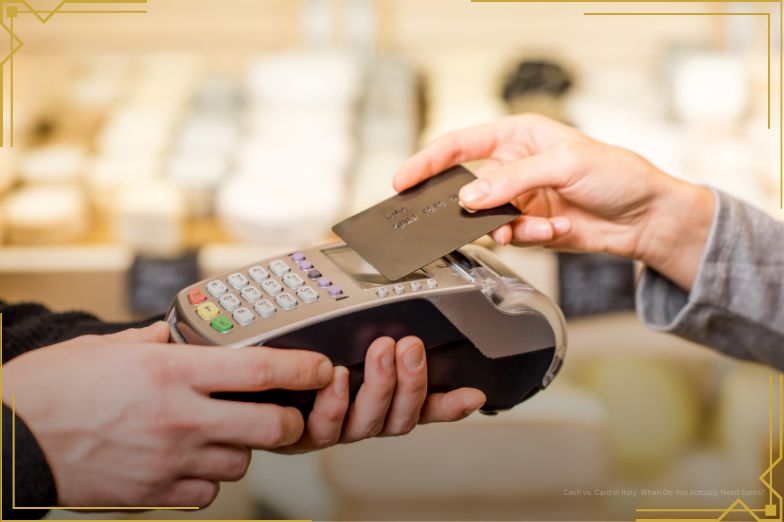
Generally, paying with a card in Italy is easy, particularly in cities and established tourist destinations. Italian rules require merchants and professionals to accept qualifying electronic payments, although technical problems and practical exceptions can still occur. Travelers should therefore expect cards to work frequently without assuming they will work in every situation.
- Visa and Mastercard are the safest primary choices. They generally offer broader acceptance than less commonly used card networks.
- Hotels, restaurants, supermarkets, museums, pharmacies, and larger shops commonly accept cards.
- Contactless payment is increasingly common, making small transactions faster and easier.
- American Express acceptance is less predictable. Upscale hotels and restaurants may accept it, while smaller independent businesses may not.
- Occasional technical failures still happen. A merchant may have a temporary problem with its POS terminal, internet connection, or payment network.
- Foreign transaction fees depend on your card issuer. Check your card’s terms before traveling rather than assuming international purchases are fee-free.
For most visitors, the lesson is simple: make a Visa or Mastercard your primary payment method and keep some euros available as backup. That combination reduces the inconvenience of carrying large amounts of cash without leaving you dependent on a single card or payment terminal.
When Do You Actually Need Cash in Italy?
Cash is no longer universally necessary for everyday purchases in Italy, but euros remain useful in several common travel situations. The need for cash tends to increase when you move away from large cities, visit very small businesses, or encounter expenses that are collected separately from your main booking.
- Small cafés and independent shops: You can often pay by card, but coins and small notes remain convenient for inexpensive purchases.
- Gelato and espresso: If you are wondering, do I need cash for gelato in Italy, the answer is usually no, but cash can still make a €2 or €3 transaction easier at a small establishment.
- Local markets: Some vendors accept cards, while others may prefer cash, especially at smaller stalls.
- Rural areas and villages: Electronic payments may be available, but connectivity and terminal reliability can be less consistent than in major cities.
- Tips: Cash is useful when leaving a few euros for a guide, driver, porter, or housekeeper.
- Tourist taxes: Some accommodations collect local tourist taxes separately, and accepted payment methods vary by property and municipality.
- Transportation outside major cities: Regional services may not offer the same contactless options available in places such as Rome.
You therefore do not need to arrive in Italy carrying hundreds or thousands of euros. A small reserve of cash, preferably including €5, €10, and €20 notes plus €1 and €2 coins, is usually more useful than carrying large-denomination notes.
How Should You Pay City Tourist Tax in Italy?
Italy does not have one universal tourist-tax payment system. Municipalities set their own rules, rates, exemptions, and collection procedures, while accommodation providers handle payment according to those local requirements. This means travelers should not assume that every hotel or vacation rental requires cash.
- Check your booking information before arrival. Some properties explain tourist-tax requirements during the booking process.
- Ask whether the tax is included in your prepaid amount. It may be charged separately even when your room is already paid.
- Confirm the accepted payment method. Depending on the property, you may be able to use cash, a card, or another payment method.
- Keep a few euros available as backup. This is particularly useful when staying at smaller hotels, B&Bs, villas, or independently managed rentals.
- Expect the amount to vary. Tourist taxes depend on factors such as the municipality, accommodation category, number of nights, and guest eligibility.
The safest approach is to confirm the details directly with your accommodation rather than relying on a blanket rule about how to pay city tourist tax in Italy. Your hotel, host, or travel planner should be able to tell you exactly what will be collected and how.
Digital Wallets: Does Apple Pay Work in Italy?
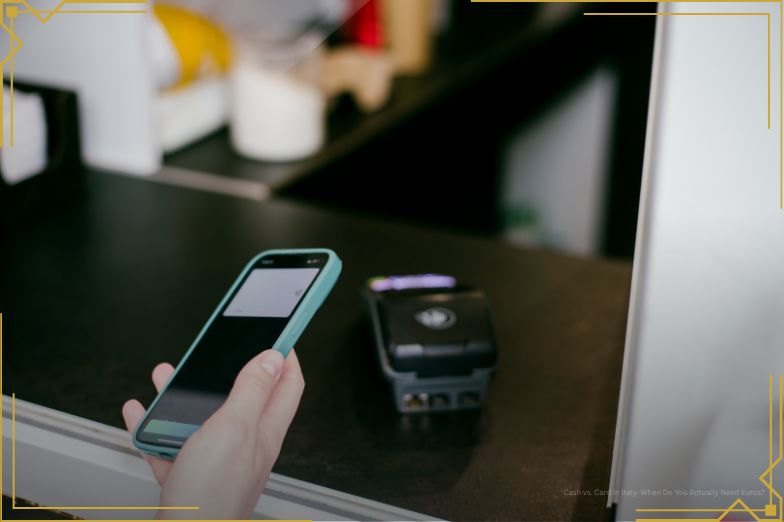
Generally, yes. Apple Pay and other NFC-based digital wallets can be used wherever the payment terminal supports compatible contactless cards, making smartphones and smartwatches useful payment tools throughout much of Italy.
- Apple Pay can be used at compatible contactless payment terminals.
- Google Pay and other supported digital wallets may also work when the underlying card and terminal are compatible.
- Rome’s ATAC transportation network supports compatible cards on NFC-enabled smartphones, smartwatches, and other devices.
- You should still carry a physical card. A dead battery, lost phone, technical error, or unsupported terminal could otherwise leave you without a payment option.
- Use the same card or device consistently on Rome’s Tap & Go system. ATAC advises passengers to continue using the same payment method used for the first tap during the ticket’s validity period.
So, can I pay with Apple Pay in Rome? In many situations, yes, including on compatible ATAC services. Treat your digital wallet as a convenient payment method, but not as a complete replacement for a physical card and a small cash reserve.
Cash or Card in Rome: Which Is Better?
If your itinerary is centered on Rome, cards and contactless payments can cover a significant share of your daily expenses. Rome’s public transportation system is particularly useful for card-oriented travelers because ATAC’s Tap & Go service accepts eligible contactless credit, debit, and prepaid cards, as well as compatible digital cards.
- Restaurants: Card is usually the easiest option.
- Museums and attractions: Online booking or card payment is often preferable.
- Metro, buses, and trams: Eligible contactless cards and supported digital devices can be used through ATAC’s Tap & Go system.
- Taxis: Card payment is common, but confirming before the ride can prevent misunderstandings.
- Espresso and gelato: Either card or a few euros in cash can work.
- Street markets: Carry cash as a backup because payment options can vary from vendor to vendor.
- Small independent businesses: Card acceptance may be available, but having cash gives you an alternative if a terminal is temporarily unavailable.
When deciding between cash or card in Rome, card should normally be your first choice, with euros serving as backup. This keeps everyday payments simple while ensuring you are prepared for the occasional cash-friendly situation.
Do Italian Taxis Take Credit Cards?
Many licensed taxis in Italy’s major cities can accept electronic payments, but travelers should avoid assuming that every vehicle, terminal, or local operator will provide exactly the same experience. Payment expectations can also differ between major cities and smaller destinations.
- Ask before starting the journey if card payment matters to you.
- A useful phrase is “Posso pagare con carta?”, meaning “Can I pay by card?”
- Taxi apps can simplify payment when the fare is processed through the app.
- Keep enough euros for a backup fare, particularly after arriving late at night or when traveling outside major tourist centers.
- Use licensed taxis or pre-arranged transportation rather than accepting unsolicited rides.
For travelers asking whether Italian taxis take credit cards, the practical answer is that card payment is often available, especially in larger cities, but carrying backup cash remains sensible.

Cash vs. Card in Italy: Quick Comparison
Italy does not require an all-cash or all-card strategy. The right payment method depends on the purchase, location, and merchant, which is why a mixed approach works best.
| Scenario / Expense | Best Payment Method | Traveler Tip |
|---|---|---|
| Sit-down Restaurants | Credit / Debit Card | Review your bill for any coperto before deciding whether to leave extra |
| Gelato & Espresso | Card or Cash | Keep €1 and €2 coins plus small notes handy |
| Taxis | Card / App, cash backup | Ask “Posso pagare con carta?” if you want to confirm |
| Rome Public Transit | Contactless Card / Digital Wallet | Use the same card or device consistently when tapping |
| Street Markets | Cash or Card | Payment options differ between individual vendors |
| Hotels | Card | Ask separately how the tourist tax is collected |
| Remote Villages | Card plus Cash Backup | Carry euros in case connectivity or card acceptance is limited |
The table illustrates why neither payment method wins in every circumstance. Cards are more practical for most significant expenses, while a modest euro reserve covers the smaller and less predictable moments of a trip.
How to Get Euros in Italy Without Paying Unnecessary Fees
For many international travelers, withdrawing euros after arriving can be more convenient than carrying a large supply of currency from home. However, the final cost depends on both the ATM operator and your own bank or card issuer, so it is worth reading the screen carefully before confirming a withdrawal.
- Look for bank-operated ATMs. In Italy, an ATM is commonly called a Bancomat.
- Major Italian banking groups include UniCredit and Intesa Sanpaolo. Using an ATM attached to a recognized bank makes it easier to identify who operates the machine.
- Check the displayed ATM fee before accepting the withdrawal.
- Your home bank may charge its own fee for international withdrawals or currency conversion.
- Check your daily withdrawal limit before departure.
- Withdraw strategically. Several small ATM visits can create more fee opportunities than fewer, carefully planned withdrawals.
- Use an ATM in a secure, well-lit location, ideally during normal banking hours when possible.
When choosing among ATMs in Italy, focus less on finding a supposed universally “free” ATM and more on understanding the total cost shown to you. ATM operator fees, your bank’s charges, and currency conversion can all affect what you ultimately pay.
How to Avoid Euronet ATM Fees in Italy
Independent ATMs, including Euronet machines commonly found in tourist areas, airports, and transportation hubs, may offer convenient access to cash. However, travelers should compare the transaction cost and conversion terms before accepting because independent ATM pricing can differ from bank-operated machines.
- Do not automatically accept the first ATM you see.
- Read all fees displayed before confirming the withdrawal.
- Pay close attention to any currency-conversion offer.
- Compare the transaction with a nearby bank-operated ATM when practical.
- Cancel the withdrawal if the displayed cost is higher than you are comfortable paying.
- Remember that your home bank may impose separate fees regardless of which ATM you choose.
The best answer to how to avoid Euronet ATM fees in Italy is not to assume every Euronet transaction has the same price. Review the exact charges offered on screen, decline an unfavorable transaction, and compare it with a bank-operated ATM.
What Is Dynamic Currency Conversion, and Should You Accept It?
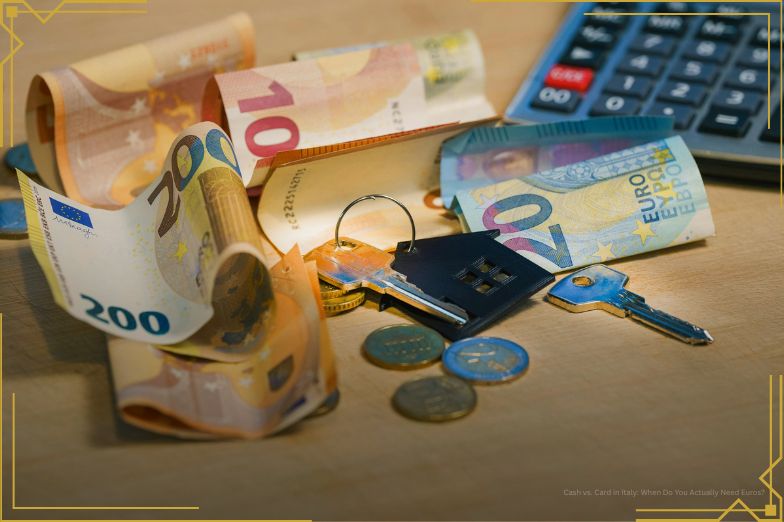
Dynamic currency conversion, or DCC, occurs when an ATM or payment terminal offers to convert a euro-denominated transaction into your home currency before you approve the payment. EU rules require providers offering currency conversion at ATMs or points of sale to disclose the conversion charges as a percentage markup over the latest available European Central Bank reference rate before the transaction.
- Look for a choice between EUR and your home currency.
- Paying in euros leaves the conversion to your card issuer or payment provider.
- Choosing your home currency activates the conversion offered by the ATM or merchant’s provider.
- Compare the displayed markup rather than accepting the conversion for convenience.
- Know your own card’s foreign-exchange terms. Choosing euros does not automatically mean your issuer charges nothing.
- Read the screen carefully before confirming. EU regulations require relevant currency-conversion information to be disclosed before the transaction.
For many travelers, choosing EUR, the local currency, is the preferable default because it lets their own card provider handle conversion. However, the strongest financial decision is to compare the actual rates and fees offered by both options rather than assuming every card issuer provides the same exchange rate.
Is American Express Accepted in Florence Restaurants?
American Express can be accepted in Florence, especially at upscale hotels, luxury retailers, and restaurants accustomed to international guests. Nevertheless, travelers should not expect AmEx acceptance to be as consistent as Visa or Mastercard at every independent café, trattoria, or family-run establishment.
- Check for card-network logos at the entrance or payment terminal.
- Ask the restaurant before ordering if AmEx is your only available card.
- Carry a Visa or Mastercard backup.
- Keep a small amount of euros available in case your preferred card network is not supported.
- Do not assume acceptance based solely on the restaurant’s price level. Individual merchants choose which card networks they support.
If you are specifically researching whether American Express is accepted in Florence restaurants, the useful answer is “sometimes, but not reliably enough to make it your only card.” A Visa or Mastercard plus a modest amount of cash provides a more dependable backup.
How Much Cash Should You Bring to Italy for Two Weeks?
There is no universal amount of cash that every traveler should carry because the answer depends on your itinerary, accommodations, transportation plans, and personal spending habits. A traveler spending two weeks in Rome, Florence, and Venice may use considerably less cash than someone exploring rural Tuscany, Sicily, or smaller villages.
- Consider keeping roughly €50 to €100 accessible at a time as a practical starting reserve rather than carrying your entire vacation budget.
- Increase your cash reserve for rural travel, outdoor markets, small villages, or independently managed accommodations.
- Use cards for larger purchases when acceptance and your card’s fee structure make that practical.
- Replenish cash from an ATM when needed instead of arriving with a large quantity.
- Split your cash and cards between secure locations rather than storing everything in one wallet.
- Avoid carrying large amounts in crowded tourist areas, where pickpocketing is an avoidable travel risk.
- Review your itinerary before determining your budget. Prepaid hotels, tours, and trains can significantly reduce the amount of physical cash you need.
For anyone searching how much cash to bring to Italy for 2 weeks, there is no magic number. What matters more is maintaining a manageable cash reserve and having reliable access to additional euros if your itinerary requires them.
What Should You Know About Tips, Coperto, and Restaurant Bills?
Italian restaurant payment customs can differ from what North American travelers are accustomed to. Understanding the difference between a coperto and a voluntary tip can help you pay confidently without assuming that a familiar tipping percentage automatically applies.
- Coperto means a cover charge. It may appear as a per-person charge on the bill.
- A coperto is not necessarily the same thing as a tip for your server.
- Large percentage-based tips are not automatically expected in the same way they are in some countries.
- Rounding up or leaving a few euros can be an appropriate gesture for good service when you choose to tip.
- Cash can be convenient for guides, drivers, housekeeping staff, and porters.
- Review the restaurant bill before adding anything extra so you understand which charges are already included.
Restaurant customs vary by establishment, so the most useful habit is simply to review the bill rather than following a rigid tipping formula. Carrying small euro notes also gives you flexibility when you want to recognize particularly good service.
Summary Checklist: What to Prepare Before You Land
A simple payment plan before departure can help you avoid unnecessary fees, card problems, and last-minute searches for an ATM. Your goal is not to predict every transaction but to ensure that you always have at least two workable ways to pay.
- Carry a Visa or Mastercard that has favorable international-use terms.
- Bring a second physical card and store it separately.
- Check your card’s foreign transaction fees before departure.
- Add your card to Apple Pay or another compatible digital wallet if desired.
- Keep around €50 to €100 in small notes and coins as a flexible starting reserve.
- Use recognizable, preferably bank-operated ATMs in Italy when the fees are reasonable.
- Review ATM operator charges before confirming a withdrawal.
- Understand dynamic currency conversion before using foreign ATMs or card terminals.
- When offered a conversion, compare the terms and generally favor paying in euros when your own card provides competitive conversion.
- Confirm how your accommodation collects its tourist tax.
- Carry additional cash when visiting rural communities or small independent establishments.
- Keep your cash, cards, passport, and valuables secure in crowded tourist areas.
With these preparations, you do not have to spend your trip worrying about whether every restaurant, taxi, or ticket machine accepts your preferred payment method. A card-first strategy backed by a modest amount of euros gives most travelers the right balance of convenience, security, and flexibility.
So, do I need euros in Italy? Yes, but you probably need far less cash than travelers once carried. For most visitors, the best cash vs. card in Italy strategy is to use a reliable credit or debit card for hotels, restaurants, transportation, and larger purchases while keeping a modest reserve of euros for small transactions, tips, local accommodations, rural stops, and technical problems. By checking your card’s fees, understanding DCC, using reputable ATMs in Italy, and carrying more than one payment option, you can spend less time worrying about money and more time experiencing Italy.
Hourglass Expeditions can design a personalized Italian journey that takes care of the practical details while leaving room for the experiences that make Italy unforgettable. Contact Hourglass Expeditions to begin planning a custom itinerary built around your interests, travel style, and preferred pace.